10 animation styles for AI video, with prompts
Claymation, anime, pixel art and seven more looks for AI video. Each has the full prompt that made it, ready to copy, and all ten are built in to TurboClip.
One shot, a film director crossing his set, made ten times in ten looks. Each look is below with the full prompt that made its clip. Copy one, swap in your own scene and keep the style.
The 10 styles
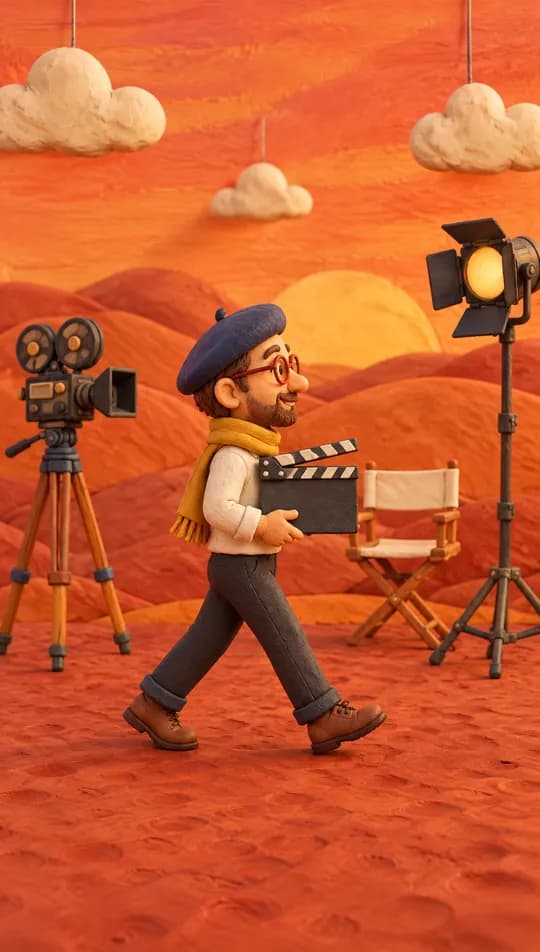
1. Claymation
Everything on screen is modelling clay, moving with the slight stutter of stop-motion. It suits brand stories and anything that should feel warm and handmade.
Built in to TurboClip as #claymation.
Make a 5-second vertical video clip (9:16) with TurboClip.

A small, friendly film director with a navy beret, round red glasses, brown hair and beard, a mustard-yellow scarf, a white shirt, dark trousers and brown shoes walks briskly from left to right across the film set, carrying a clapperboard in front of him in both hands. Behind him are a film camera on a tripod, a director's chair and a studio light on a stand. Side-on view, full body: the camera tracks sideways with him, so he stays in the centre of the frame at the same size.

World: A handmade stop-motion film set on a tabletop. Rolling hills of orange and terracotta modelling clay under a painted cardboard sunset sky in warm orange and coral, fat cream clay clouds hanging on visible wires, and a floor of rust-red clay covered in thumbprints. A palette of orange, terracotta, coral and cream in warm golden light.

Style: Claymation stop-motion aesthetic: everything on screen is made of modelling clay — the subjects, the props, the ground and the background. Handmade stop-motion, moving frame by frame with a slight, charming stutter. Matte modelling-clay surfaces with visible fingerprints and tool marks, and the charming irregularity of figures shaped by hand. Soft key light like a real miniature set, warm and golden when the mood is cosy, with gentle contact shadows and shallow miniature depth of field. The look of lovingly crafted stop-motion animation: a little uneven, full of texture, unmistakably physical. The medium's signature is handmade warmth and presence — molded by hand, never slick CGI, never drawn. Whatever the subject, the treatment should feel playful, tactile, and full of character.

No text, captions, lettering, logos or watermarks.
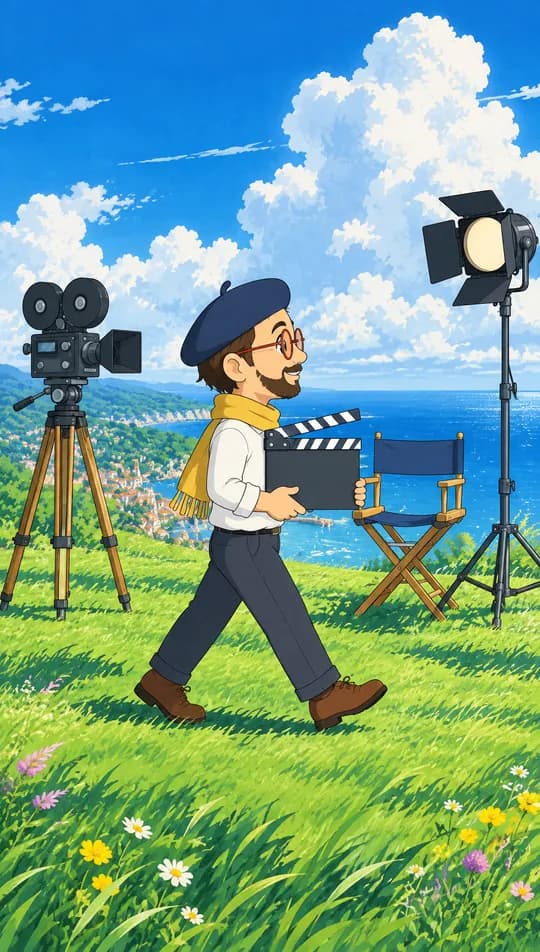
2. Anime
Hand-drawn 2D in the Japanese cel tradition: clean ink lines, flat colour and painted backgrounds. It suits stories with feeling, and ordinary moments that should look like a film's turning point.
Built in to TurboClip as #anime.
Make a 5-second vertical video clip (9:16) with TurboClip.

A small, friendly film director with a navy beret, round red glasses, brown hair and beard, a mustard-yellow scarf, a white shirt, dark trousers and brown shoes walks briskly from left to right across the grassy hilltop, carrying a clapperboard in front of him in both hands. Behind him are a film camera on a tripod, a director's chair and a studio light on a stand. Side-on view, full body: the camera tracks sideways with him, so he stays in the centre of the frame at the same size.

World: An outdoor film shoot on a grassy hilltop in high summer. A huge, vivid blue sky filled with towering white cumulus clouds, bright green grass and wildflowers bending in the wind, and far below a small seaside town and a glittering sea. A palette of saturated sky blue, white and fresh green, in clear midday sun with crisp drawn shadows.

Style: Hand-drawn 2D anime aesthetic, in the tradition of Japanese cel animation. Everything is drawn, never modelled: clean, confident ink linework round every shape, flat fields of colour with a single hard-edged shadow tone, and simple drawn highlights — no soft airbrushed gradients, no 3D rendering, no glossy reflections, no photographic depth of field. Characters have anime faces and proportions: large expressive eyes with bright highlights, a small simple nose and mouth, and hair drawn in bold, clean clumps. Backgrounds are hand-painted in gouache, with painterly detail and atmospheric depth — clearly a painted backdrop behind flat, cel-coloured characters. Light is drawn, not simulated: a shaft of light or a glow is a painted shape, and a shadow is a flat shape of darker colour. In motion it moves like traditional animation, drawn on twos, with held poses and snappy, expressive timing. The medium's signature is emotional resonance and the extraordinary-within-the-ordinary — ordinary moments drawn like the turning point of a film. Whatever the subject, anime's visual language elevates it.

No text, captions, lettering, logos or watermarks.
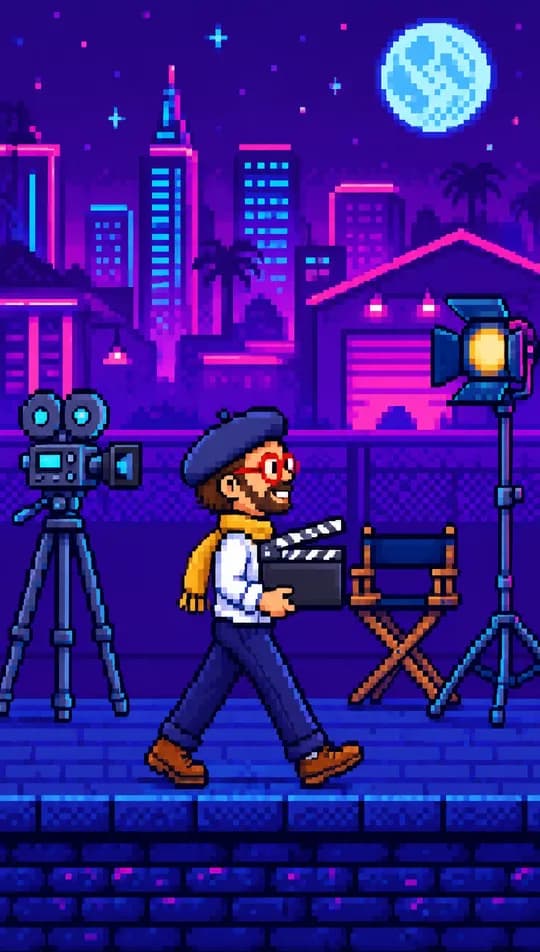
3. Pixel Art
A 16-bit video game come to life, in chunky square pixels and a punchy palette. It suits gaming, nostalgia and tech with a sense of humour.
Built in to TurboClip as #pixel-art.
Make a 5-second vertical video clip (9:16) with TurboClip.

A small, friendly film director with a navy beret, round red glasses, brown hair and beard, a mustard-yellow scarf, a white shirt, dark trousers and brown shoes walks briskly from left to right across the brick walkway, carrying a clapperboard in front of him in both hands. Behind him are a film camera on a tripod, a director's chair and a studio light on a stand. Side-on view, full body: the camera tracks sideways with him, so he stays in the centre of the frame at the same size.

World: A side-scrolling platform-game level at night. A neon city film lot under a deep purple sky with a big pixel moon and stars, buildings lit in magenta and cyan neon in flat parallax layers, and a walkway of dark blue brick tiles under his feet. A palette of deep purple, magenta, hot pink and cyan. No game interface, no score, no hearts.

Style: Pixel art aesthetic: a 16-bit video game come to life. Everything is built from chunky, clearly visible square pixels on a coarse grid — crisp hard edges, no anti-aliasing, no smooth gradients, no blur — in a limited, punchy palette with dithered shading and dark one-pixel outlines. Characters are sprites with simple, readable shapes; backgrounds are flat, layered scenery like a side-scrolling platform game. In motion it moves like sprite animation: a few held frames for each action, snappy and slightly stepped, with the scenery scrolling past in flat layers. No depth of field, no photographic light, no 3D shading, and no game interface, score or lettering. The medium's signature is nostalgic game charm — every frame could be a screenshot from a classic console game. Whatever the subject, the treatment should feel playful, crisp, and instantly retro.

No text, captions, lettering, logos or watermarks.
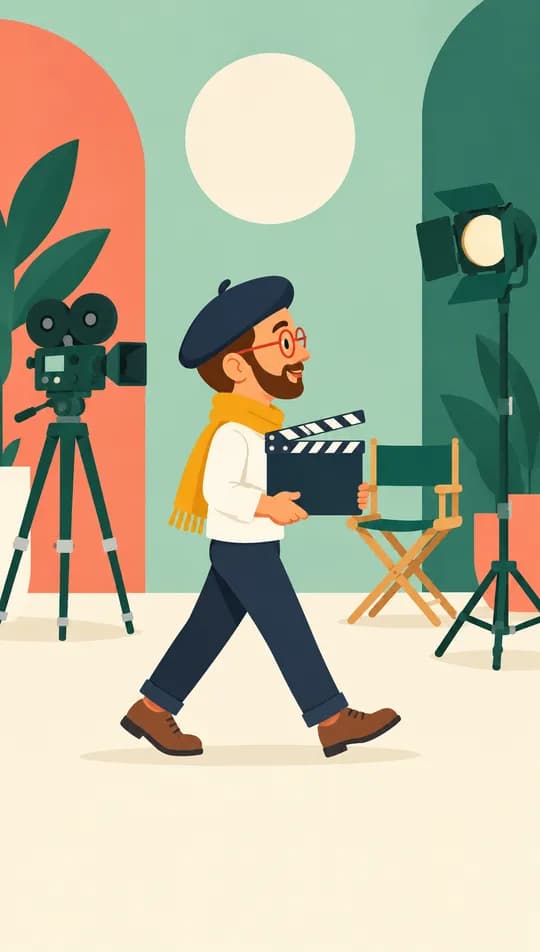
4. Flat Vector
Clean geometric shapes in flat colour, the look of modern explainer and product graphics. It suits how-it-works videos and ideas that need to be clear.
Built in to TurboClip as #flat-vector.
Make a 5-second vertical video clip (9:16) with TurboClip.

A small, friendly film director with a navy beret, round red glasses, brown hair and beard, a mustard-yellow scarf, a white shirt, dark trousers and brown shoes walks briskly from left to right across the studio, carrying a clapperboard in front of him in both hands. Behind him are a film camera on a tripod, a director's chair and a studio light on a stand. Side-on view, full body: the camera tracks sideways with him, so he stays in the centre of the frame at the same size.

World: A clean modern studio made of flat shapes. A mint-green wall carrying large simple forms (a big cream circle like a sun, tall coral and deep-green arches, and big potted plants drawn as plain leaf shapes) over a cream floor. A limited palette of mint green, cream, coral and deep forest green, with no outlines, no texture and no shading beyond a flat shadow shape.

Style: Friendly flat-vector illustration aesthetic. Clean geometric shapes with smooth flat fills, rounded forms, and a harmonious modern palette — the warm, approachable look of contemporary explainer and product graphics. Crisp vector edges with optional soft gradients for gentle depth; simplified characters and objects pared down to clear, friendly forms. More populated and colorful than stark minimalism — built to make ideas and processes easy to follow. The medium's signature is clarity with warmth. Whatever the subject, the treatment should feel modern, helpful, and effortlessly clear.

No text, captions, lettering, logos or watermarks.
5. Comic Book
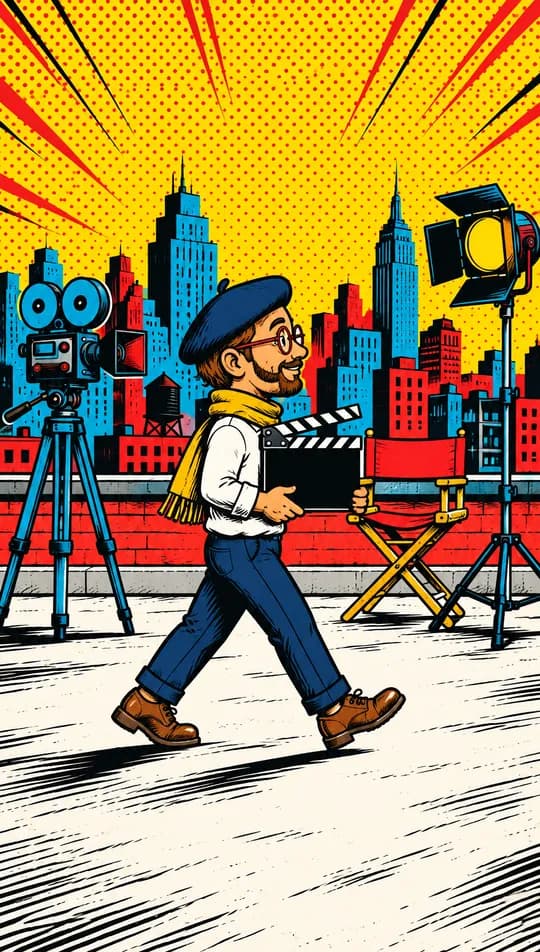
Bold ink, spot blacks and halftone dots under flat, punchy colour, with speed lines on the big beats. It suits action, announcements and drama.
Built in to TurboClip as #comic.
Make a 5-second vertical video clip (9:16) with TurboClip.

A small, friendly film director with a navy beret, round red glasses, brown hair and beard, a mustard-yellow scarf, a white shirt, dark trousers and brown shoes walks briskly from left to right across the city rooftop, carrying a clapperboard in front of him in both hands. Behind him are a film camera on a tripod, a director's chair and a studio light on a stand. Side-on view, full body: the camera tracks sideways with him, so he stays in the centre of the frame at the same size.

World: A film shoot on a city rooftop, as one pop-art comic panel. A bright yellow sky filled with red halftone dots and radiating action lines, a skyline of buildings in flat cyan and red with heavy black shadows, and a white rooftop floor with black hatching. A palette of primary yellow, red and cyan with solid black ink.

Style: Graphic novel comic aesthetic. Bold inked linework with expressive line weight, dramatic spot blacks, halftone dot shading, and flat, punchy colour laid over the ink — often a bold, electric two-tone palette. In motion it moves like stylised comic-book animation, with speed lines on the big beats. Heightened, cinematic drama in the tradition of modern comic books and graphic novels. A single illustrated frame — never a page of panels, never speech balloons or lettering. The medium's signature is dramatic storytelling — every image reads like the turning point of the story. Whatever the subject, the treatment should feel bold, dramatic, and narrative-driven.

No text, captions, lettering, logos or watermarks.
6. 3D Animation
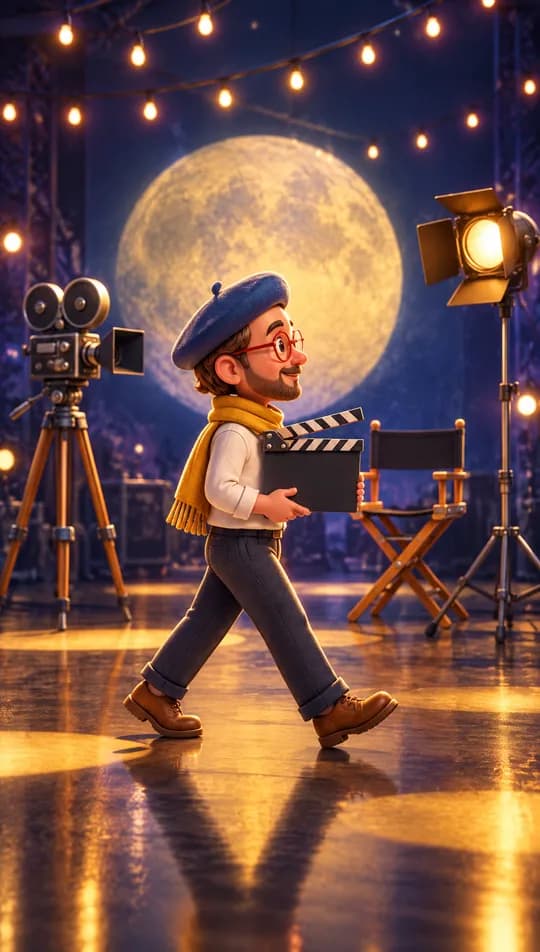
Stylised 3D with feature-film polish: big expressive eyes, soft light and rich detail. It suits characters, mascots and family stories.
Built in to TurboClip as #3d-render.
Make a 5-second vertical video clip (9:16) with TurboClip.

A small, friendly film director with a navy beret, round red glasses, brown hair and beard, a mustard-yellow scarf, a white shirt, dark trousers and brown shoes walks briskly from left to right across the night soundstage, carrying a clapperboard in front of him in both hands. Behind him are a film camera on a tripod, a director's chair and a studio light on a stand. Side-on view, full body: the camera tracks sideways with him, so he stays in the centre of the frame at the same size.

World: A big film soundstage at night. Deep midnight-blue darkness, a giant glowing full moon painted on the backdrop, strings of warm fairy lights overhead, and pools of golden spotlight on a polished dark floor that reflects them. A palette of deep navy and indigo with gold and amber light; a warm rim of light picks him out of the dark.

Style: Stylised 3D animation and render aesthetic with feature-film polish. For people and creatures: believable proportions for each age, with the stylisation in the face — large glossy eyes with bright catchlights, thick expressive brows, softly caricatured features, cheeks and nose that flush with feeling. Every face in frame is stylised the same way — never a photoreal or half-real face beside a stylised one. Subsurface-lit skin, hair sculpted in soft locks with highlights, fabric with a real weave. For objects and concepts: crisp, precise forms with clean, believable materials, and soft rounded shapes in bright, saturated colour where the subject is playful. Motivated warm-and-cool light from the scene's own sources, soft global illumination, gentle ambient occlusion, soft bloom, creamy background bokeh. The medium's signature is dimensional polish and feeling you can read at a glance — rendered, not drawn, not photographed. Whatever the subject, the treatment should feel solid, warm, expressive, and cinematic.

No text, captions, lettering, logos or watermarks.
7. Cartoon
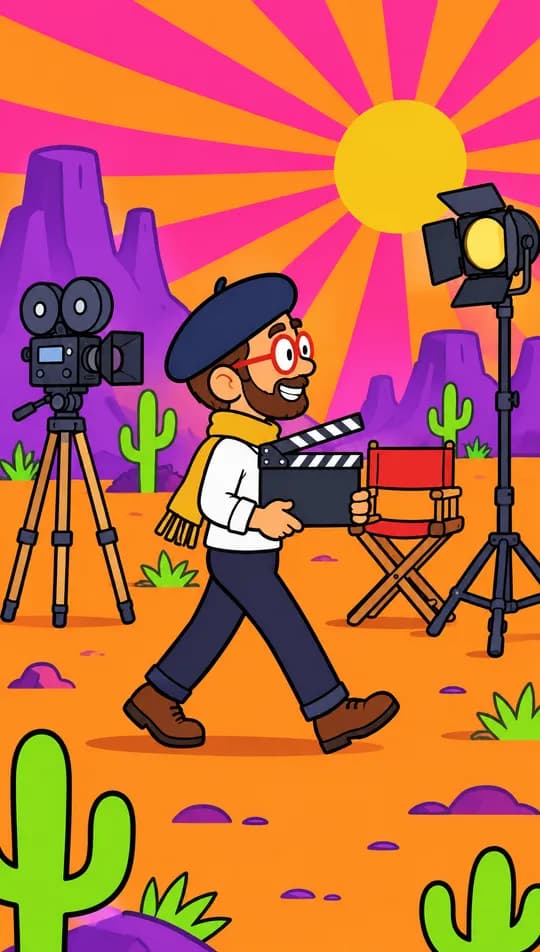
Clean confident outlines and bright flat colour, with the energy of modern Western animation. It suits comedy, kids' content and anything lively.
Built in to TurboClip as #cartoon.
Make a 5-second vertical video clip (9:16) with TurboClip.

A small, friendly film director with a navy beret, round red glasses, brown hair and beard, a mustard-yellow scarf, a white shirt, dark trousers and brown shoes walks briskly from left to right across the cartoon desert, carrying a clapperboard in front of him in both hands. Behind him are a film camera on a tripod, a director's chair and a studio light on a stand. Side-on view, full body: the camera tracks sideways with him, so he stays in the centre of the frame at the same size.

World: A wacky cartoon desert film set. A hot-pink and orange sunburst sky with radiating stripes, wonky purple mesas and lime-green cacti with thick outlines, and a bright orange desert floor. A loud palette of hot pink, orange, lime green and purple, in flat colour everywhere.

Style: Bold cartoon illustration aesthetic. Clean confident outlines, simplified expressive forms, and flat-to-cel shading with punchy, bright saturated colour, over simple, uncluttered backgrounds that keep the subject clear. The energy of modern Western animation and comic art — lively, characterful, and instantly readable. Exaggeration is welcome: shapes are bold, expressions are big, and detail is reduced to what reads at a glance. The medium's signature is outlined, graphic clarity with personality. Whatever the subject, the treatment should feel fun, energetic, and approachable.

No text, captions, lettering, logos or watermarks.
8. Retro Low-Poly
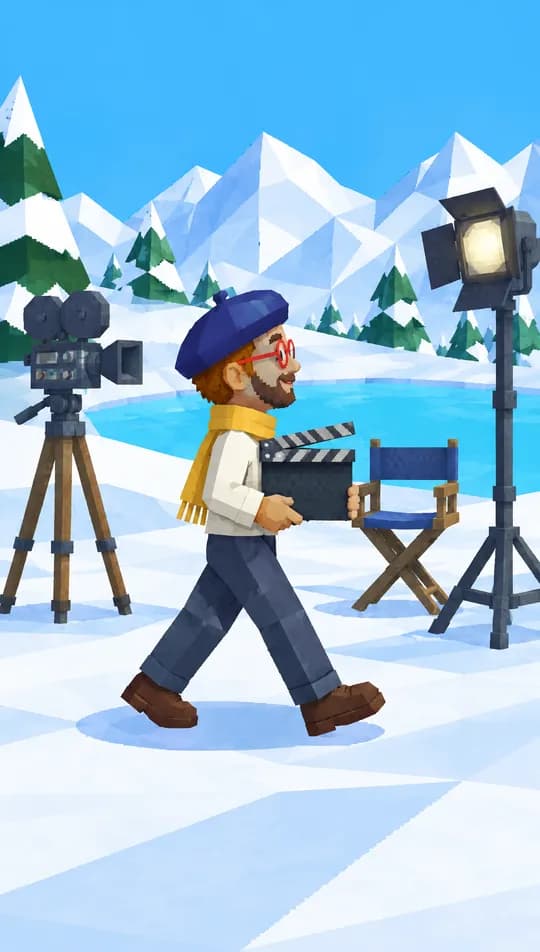
An early-2000s console game come to life: faceted 3D models, hard edges and chunky textures. It suits gaming, retro tech and playful throwbacks.
Built in to TurboClip as #low-poly.
Make a video in Retro Low-Poly
Make a 5-second vertical video clip (9:16) with TurboClip.

A small, friendly film director with a navy beret, round red glasses, brown hair and beard, a mustard-yellow scarf, a white shirt, dark trousers and brown shoes walks briskly from left to right across the snow level, carrying a clapperboard in front of him in both hands. Behind him are a film camera on a tripod, a director's chair and a studio light on a stand. Side-on view, full body: the camera tracks sideways with him, so he stays in the centre of the frame at the same size.

World: The snow level of an early 3D adventure game, on a bright clear day. A flat plane of white low-polygon snow with pale-blue shadow facets, angular dark-green pine trees capped with white, a frozen pond of flat bright cyan, jagged white low-polygon mountains, and a clear, saturated ice-blue skybox. A crisp, bright palette of white, ice blue and cyan with dark green accents. No fog, no grey.

Style: Retro low-poly aesthetic: an early-2000s console video game come to life. Everything is built from simple, visibly faceted 3D models with a very low polygon count — angular silhouettes, flat-shaded faces with hard edges between them, and low-resolution textures with chunky visible pixels stretched over the shapes, with no smoothing. Characters have blocky mitten hands, simple faces painted onto the head as a texture, and stiff, segmented limbs; scenery is sparse and geometric, with flat ground planes and simple boxy props. Plain, even lighting with a simple round blob shadow under each figure, slight colour banding and jagged, stair-stepped aliased edges, as if rendered at a low resolution and shown on a tube television. In motion it moves like an old game character: a simple looping walk cycle, a little stiff and floaty, with the camera gliding like a third-person game camera. No modern rendering — no ray tracing, no soft global illumination, no fine detail, no depth of field, no smooth curves. The medium's signature is nostalgic, low-fi 3D charm — every frame could be a cutscene from a classic console game. Whatever the subject, the treatment should feel retro, chunky, and playful.

No text, captions, lettering, logos or watermarks.
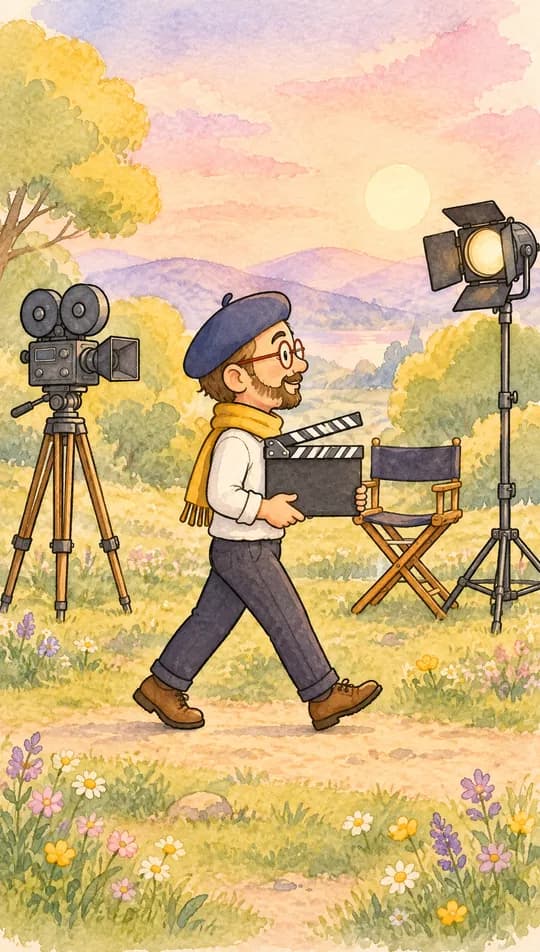
9. Storybook
A picture book come to life: thick ink outlines, soft watercolour washes and rounded characters. It suits children's stories and gentle brands.
Built in to TurboClip as #storybook.
Make a 5-second vertical video clip (9:16) with TurboClip.

A small, friendly film director with a navy beret, round red glasses, brown hair and beard, a mustard-yellow scarf, a white shirt, dark trousers and brown shoes walks briskly from left to right across the meadow path, carrying a clapperboard in front of him in both hands. Behind him are a film camera on a tripod, a director's chair and a studio light on a stand. Side-on view, full body: the camera tracks sideways with him, so he stays in the centre of the frame at the same size.

World: A woodland meadow at dawn, in a picture book. A soft peach and pink sky with a pale sun, lavender hills, round trees in butter yellow and sage green, and a meadow path dotted with tiny flowers, the paper's white showing at the edges of the washes. A pastel palette of peach, pink, lavender and butter yellow.

Style: Storybook cartoon aesthetic. Hand-drawn 2D cartoon with thick, bold ink outlines and soft watercolour washes in bright pastel colours, with cute, rounded characters — a picture book come to life. The medium's signature is tender, hand-drawn sweetness. Whatever the subject, the treatment should feel warm, gentle, and full of heart.

No text, captions, lettering, logos or watermarks.
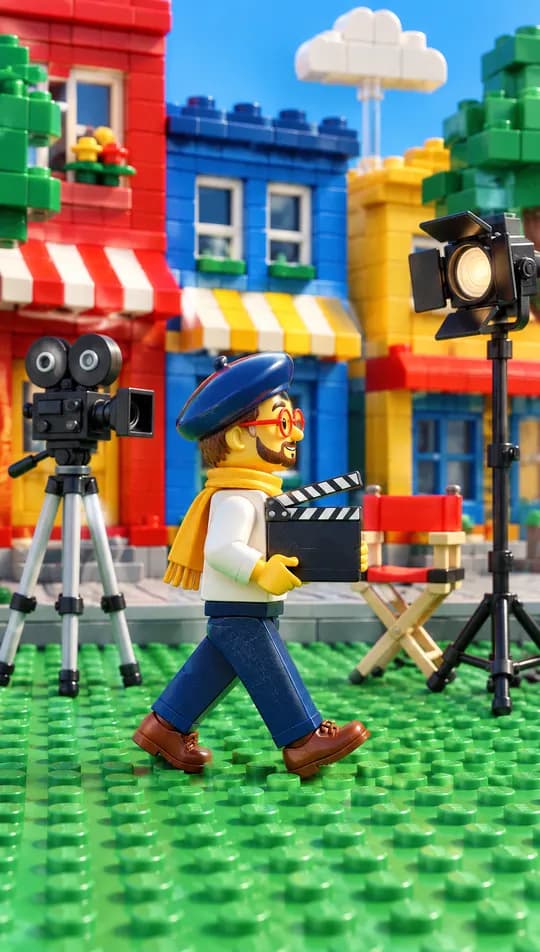
10. Toy Bricks
Everything is built from plastic toy construction bricks, the people included. It suits playful explainers, product jokes and anything for builders.
Built in to TurboClip as #toy-bricks.
Make a 5-second vertical video clip (9:16) with TurboClip.

A small, friendly film director with a navy beret, round red glasses, brown hair and beard, a mustard-yellow scarf, a white shirt, dark trousers and brown shoes walks briskly from left to right across the toy-brick street, carrying a clapperboard in front of him in both hands. Behind him are a film camera on a tripod, a director's chair and a studio light on a stand. Side-on view, full body: the camera tracks sideways with him, so he stays in the centre of the frame at the same size.

World: A toy-brick city street dressed as a film set. Brick-built shopfronts in bright red, blue and yellow, a white brick-built cloud on a clear stand, green brick trees, and a bright green studded baseplate for the ground. A palette of primary red, blue, yellow and green in glossy plastic, under bright, clean daylight.

Style: Toy brick aesthetic: everything on screen is built from plastic interlocking toy construction bricks — the characters, the props, the ground and the background. Characters are small toy-brick minifigures with cylindrical heads, simple printed faces, blocky torsos, C-shaped clamp hands and stiff, hinged legs; scenery is assembled brick by brick, with round studs on the top surfaces and visible seams between the pieces. Glossy moulded plastic in bright primary colours, with tiny scuffs, soft reflections and the slight unevenness of a model built by hand. Lit like a real miniature set, with soft studio light, gentle contact shadows and shallow macro depth of field. In motion it moves like brick-film stop-motion: stiff-legged and a little jerky, hinges swinging, nothing bending that plastic couldn't. No brand names, logos or embossed words on any brick. The medium's signature is toy-box charm — the whole world could be tipped back into the box. Whatever the subject, the treatment should feel playful, tactile, and inventive.

No text, captions, lettering, logos or watermarks.
Three ways to use a style
In Director, for a whole video
Director turns one idea into a finished video. It writes the script, plans every shot and voices it, and you approve the plan before anything renders.
- Open Director and describe your video.
- Press Style and pick the look by its tag, such as
#claymation. - Approve the plan. Every scene is made in that style.
The buttons on this page open Director with the style already picked.
In Create video, for one clip
For a single short clip, like the ones in the Reel, use Create video. Paste a whole prompt from this page, pick a video model and generate. Or type only your scene and choose the look with the Style button there.
In Claude, ChatGPT or another assistant
Connect TurboClip once, then paste a prompt into the chat. The assistant shows the price, then makes the clip. It works in Claude, ChatGPT, Codex, Cursor and any assistant that takes MCP connectors, and every clip in the Reel was made in a Claude chat.
Make a prompt your own
Each prompt has four parts:
- The opening line says what to make: a 5-second vertical clip. Change the length or the shape there.
- The scene is the first paragraph: who or what is in the shot, and what happens. Swap in yours.
- World is the place, the colours and the light. Keep ours, or describe your own.
- Style is the look itself. Keep it word for word.
The last line keeps words and logos out of the picture.
How the Reel's clips were made
Each clip began as a still picture, drawn from one line sketch so the director stands in the same place in all ten. The pictures were made with GPT Image 2.5, and Omni 1.2 Flash then animated each one for five seconds, all in a Claude chat with TurboClip connected.
Pasted as they are, the prompts above give the same look in one step. Your framing will differ a little from ours.
Questions & answers
Are these animation styles built in to TurboClip?
Yes, all ten. In Director or Create video, press Style and pick the look by its tag, such as #claymation or #pixel-art. You only need the prompts on this page to use the looks in a chat, or to see how they are written.
Can I use these prompts in Claude or ChatGPT?
Yes, once TurboClip is connected. Paste a prompt into the chat and the assistant shows the price, then makes the clip with TurboClip.
Which AI models made the clips?
Each clip started as a still made with GPT Image 2.5, which Omni 1.2 Flash then animated for five seconds at 720p. The styles are written as plain descriptions, so they work with other image and video models too.
How do I keep my character the same in every style?
Keep the first paragraph, the one that describes the character and the action, word for word, and change only World and Style. For a closer match, make one picture of the character first and give it to each clip as a reference image.
Can I change the length or the shape of the clip?
Yes. The first line of each prompt asks for a 5-second vertical clip. Change it to what you need, such as a 10-second 16:9 clip. The lengths on offer depend on the video model.
What does a clip cost?
Each clip uses credits, and TurboClip shows the price before anything is made. The price depends on the video model, the length and the resolution, and every model's rate is on the pricing page.